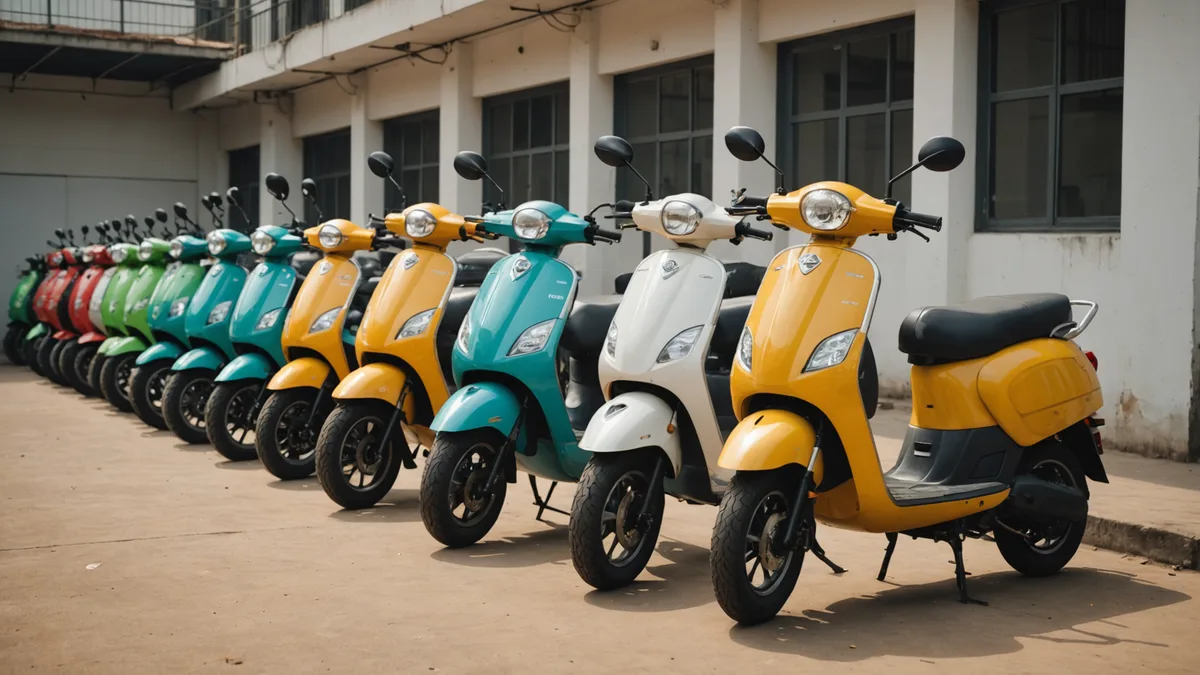
The fleet operators who switched their delivery scooters to electric vehicles in 2023 and 2024 were early enough that they could not simply look up how to do it. The playbook did not exist yet in any usable form. The OEM documentation told you about the vehicle. It did not tell you what would happen when one of your riders misread the range estimate and got stranded 15 km from a charger on a Tuesday afternoon during the lunch rush.
We spent considerable time in 2023 observing how early-adopter fleets in Pune navigated that first year. The patterns across their experiences were consistent enough to be worth documenting, because the same problems appear every time a new fleet makes the transition without adequate preparation.
Range Estimation Is the First Problem
The stated range on an electric scooter's specification sheet is calculated under test conditions that differ from actual delivery fleet use in meaningful ways. Rider weight, load weight (a delivery bag with 10 kg of orders versus an empty rack), ambient temperature, road surface, and riding style all affect real-world range. In Pune, where ambient temperatures in summer regularly exceed 35 degrees and where traffic patterns mean frequent acceleration-deceleration cycles, real-world range for a delivery scooter in fleet use is typically 15-25% below the stated specification.
First-year fleet managers who communicate stated range to their riders and plan routes accordingly discover this gap through rider incidents, not through pre-planning. A scooter rated at 120 km range delivering 90-100 km of effective range under actual conditions changes the viability of certain route configurations significantly. Calibrating this early, through structured testing of actual range under real load and temperature conditions before scaling the fleet, saves considerable operational disruption later.
The secondary problem is the range anxiety behavioral response. Riders who have been stranded once become conservative about how far they will travel before seeking a charge. Conservative range management is operationally rational from the rider's perspective but results in more frequent, shorter charging stops that eat into shift time more than less-frequent longer stops would. Fleet managers who do not measure this effect end up with lower delivered orders per shift than their range specifications should theoretically allow.
Charging Infrastructure: The Operational Discovery
Most first-year fleet operators underestimate the operational complexity of charging logistics. The assumption is: plug in when low, charge up, continue. The reality in a multi-rider fleet without a dedicated depot includes: uneven charger availability during peak delivery hours, riders who do not communicate when they have left a vehicle plugged in at a shared commercial charger (blocking other fleet vehicles), and the fundamental problem that charging a battery fast enough to matter for mid-shift operations typically requires equipment that most commercial charging points in Indian urban areas do not yet provide.
Fleet operators who built the transition around home-based charging for their riders encountered a related set of problems. Riders living in older housing societies without designated EV charging provisions faced building management opposition or unreliable access to outlets. Riders in shared accommodations with multiple people on a single meter found their monthly electricity bills becoming a friction point. These problems are not unique to delivery operations but they surface earlier and more acutely when the vehicle is being used for 8-10 hours daily rather than occasional personal travel.
Maintenance Patterns That Surprised Early Fleet Managers
Electric scooters have substantially lower maintenance requirements than petrol equivalents in most categories. No oil changes, no air filter replacements, fewer brake wear events due to regenerative braking. First-year fleet operators who made the transition on the expectation of lower maintenance costs were generally right about this overall.
What surprised many was the distribution of maintenance events. Petrol scooters fail gradually and predictably in ways that an experienced mechanic can anticipate and schedule. Electric scooters tend to fail less often but more suddenly in the categories that do fail: battery management system faults, motor controller issues, and connector degradation from daily plug-in cycles. Riders who experience sudden non-starts at the beginning of a shift have a worse experience than riders whose petrol vehicle gradually becomes harder to start over several days.
The practical implication for year-one fleet management is: build a relationship with a service provider who has actual EV scooter experience before you need them urgently, and log every electrical fault event, however minor, because intermittent faults in EV systems often precede harder failures and early pattern recognition prevents stranded vehicles.
Battery Pack Management as a Separate Discipline
Fleet operators who own their battery packs discover quickly that pack management is a separate operational discipline from vehicle management. Tracking each pack's condition, managing the charge cycle schedule, replacing packs before they degrade to the point of rider complaints, and handling the occasional pack that shows rapid unexpected degradation, these tasks are real ongoing work that does not automatically come with the vehicle purchase.
The fleets we observed that handled this best in year one were the ones that assigned explicit ownership of pack management to a specific person in the operation, with a simple tracking system (even a spreadsheet) that logged each pack's history. The fleets that handled it worst were the ones that assumed the vehicles would manage the battery issue themselves or that the OEM warranty would handle degradation problems. Battery pack warranty terms in the Indian EV scooter market in 2023-2024 were narrower than many fleet operators realized at the time of purchase.
What Year One Teaches
The consistent finding across early-adopter fleets is that the vehicle itself is not the difficult part of the transition. Electric scooters for delivery use are well-suited to the application when range expectations are calibrated correctly and maintenance patterns are understood. The difficult parts are all infrastructure-adjacent: charging logistics, pack management, and the operational systems to coordinate energy access across a multi-rider fleet.
Fleets that build energy access systems before scaling, whether through depot charging, swap network access, or some combination, tend to have more manageable year-one experiences. Fleets that scale the vehicle fleet without first solving the energy logistics end up solving the logistics problem reactively, at higher operational cost, while already running a fleet that depends on the answer. Planning the energy access layer before or alongside the vehicle acquisition, not after, is the clearest lesson from watching early-adopter fleets navigate the transition.